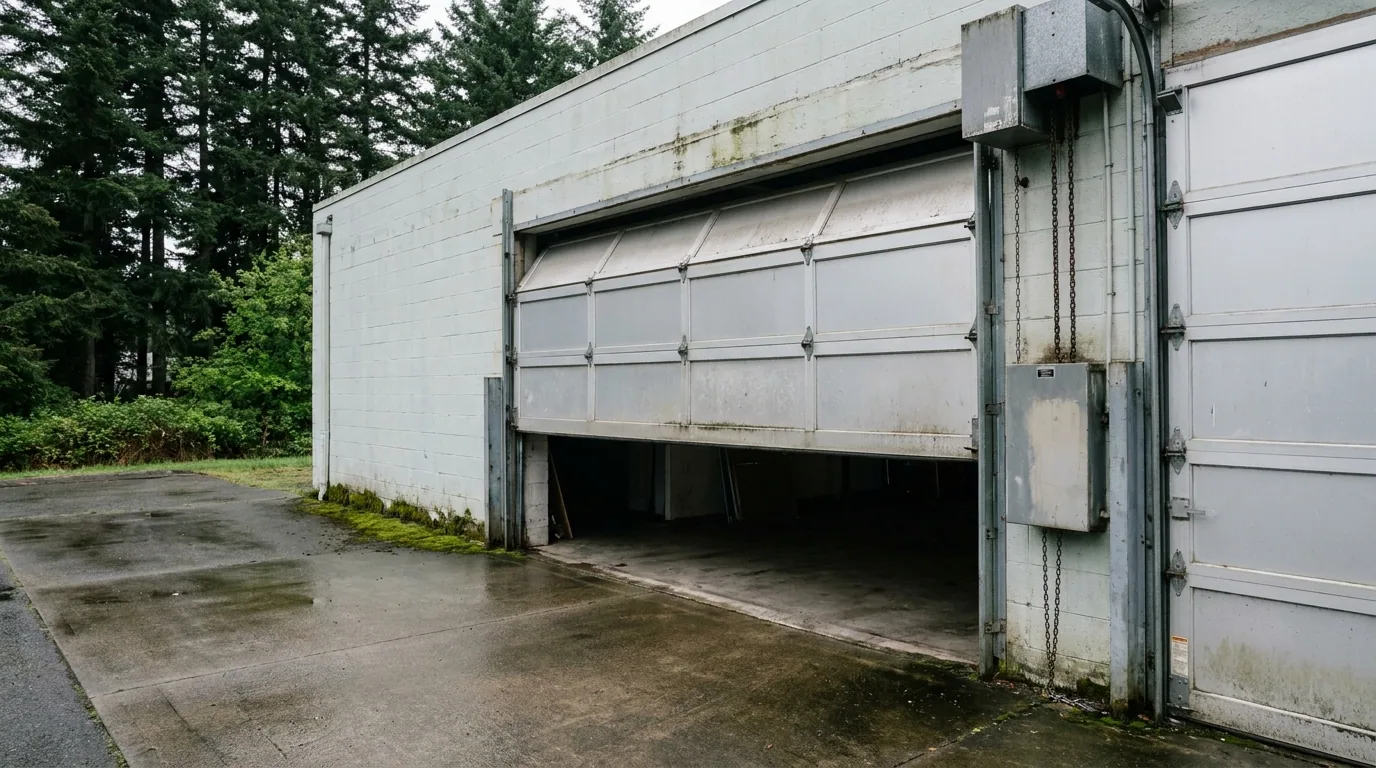
Properties out toward Enumclaw and Bonney Lake often have a garage that has been in service far longer than the house's current owners realize. A detached building with a single-car door, a sloped driveway, and a door that has been opened and closed several times a day for decades is a different situation from a builder-grade door in a newer subdivision. Two things tend to drive the problems on these doors: constant damp, and steady heavy use. Neither one fails a door overnight. Both work on it slowly, and the symptoms they produce overlap with each other and with ordinary wear. This article covers what you can safely observe from outside the door with the garage empty, which causes are most likely when something changes, and which parts of the job belong to a technician.
What damp actually does to an older door
In this part of Washington, hardware spends most of the year in moist air. That matters most for the steel parts that move against each other: hinges, rollers, and the pivot points where the sections connect. Rust and stiffness build up gradually, and a hinge that was smooth a few years ago can start to drag without anything visibly breaking.
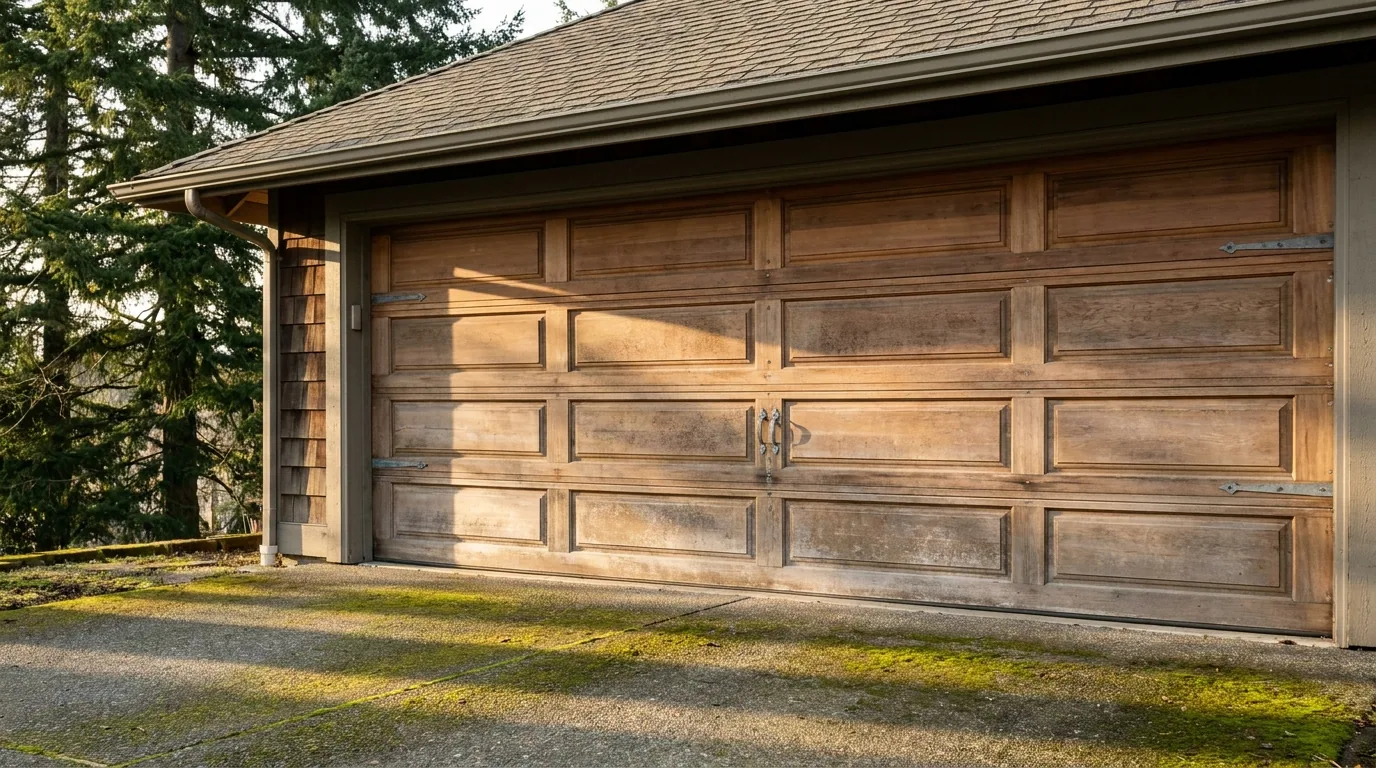
Wooden doors respond to the same conditions differently. Wood takes on and gives off moisture with the seasons, and an older wooden door that has been through many wet cycles may no longer sit as flat or as square as it once did. A door that binds in one spot, or that needs a little more effort to close than it used to, is worth having a technician look at rather than forcing.
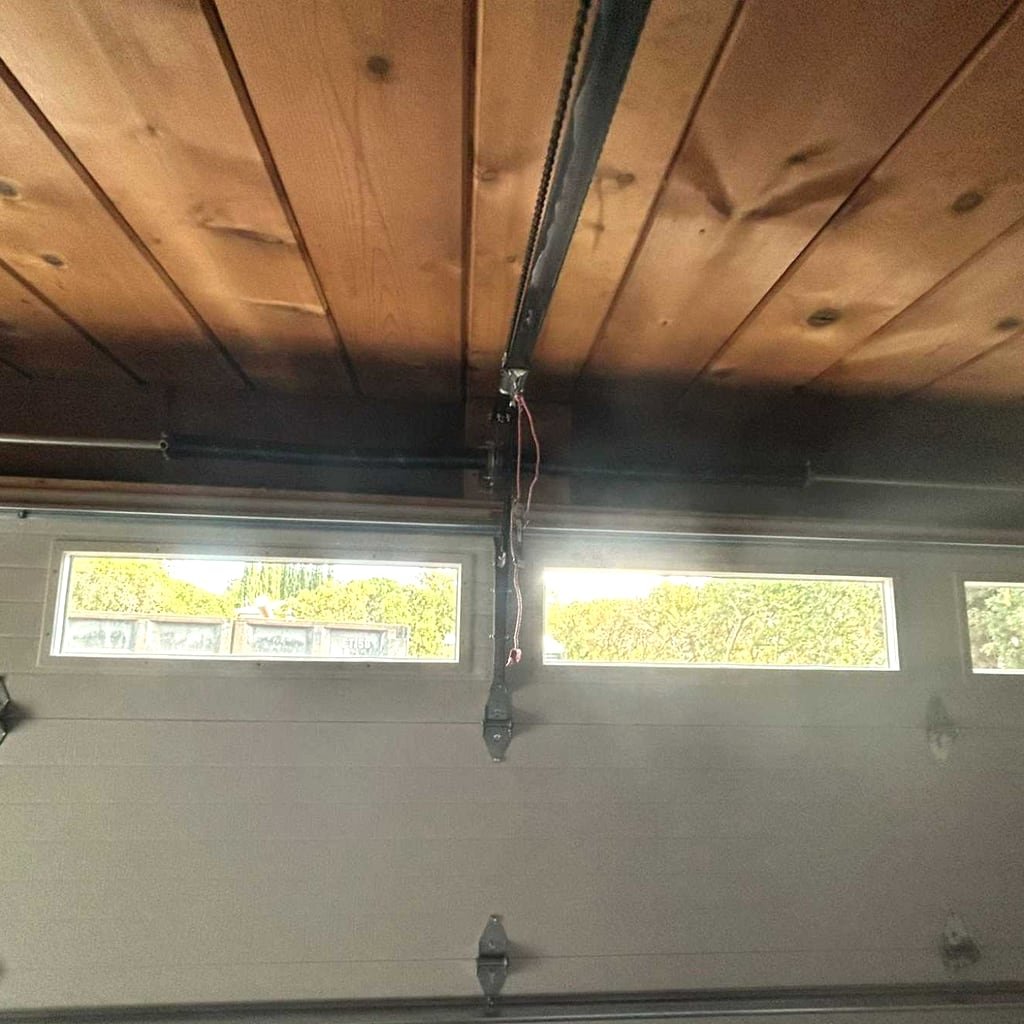
What you can observe yourself, with the garage empty and the door closed, is limited but useful. Does the door sit square in the opening, or is one side of the bottom edge higher than the other? Is there a gap along the top on one side? Does the door sound different at the start of a cycle than it did a season ago? Those observations help a technician narrow things down before anyone touches the hardware.
Heavy daily use and what it wears first
A door on a working property may cycle many more times a day than a suburban door, and the parts that wear are the ones in constant motion. Rollers, hinges, and the bottom seal tend to show the strain before the springs do. A bottom seal that has hardened or torn lets water and grit in along the floor, which in turn puts more load on the hardware above it.
A door that feels heavier in normal use, or that hesitates at one point in its travel, is telling you something has changed. It is not a diagnosis on its own. A door that feels heavy can come from worn rollers, a tired spring, or a track that is no longer straight, and those are three different repairs. The way to separate them is for a technician to check the springs, cables, rollers, and track together, because they work as a system.
Noises that are worth taking seriously
A new noise at the start of a cycle is one of the most useful things an owner can report. A squeal can come from a dry roller, a hinge that needs attention, or a bearing that has worn. A grinding sound may point to a roller or to the opener's drive. A bang or a snap followed by a door that will not stay up is a different category entirely.
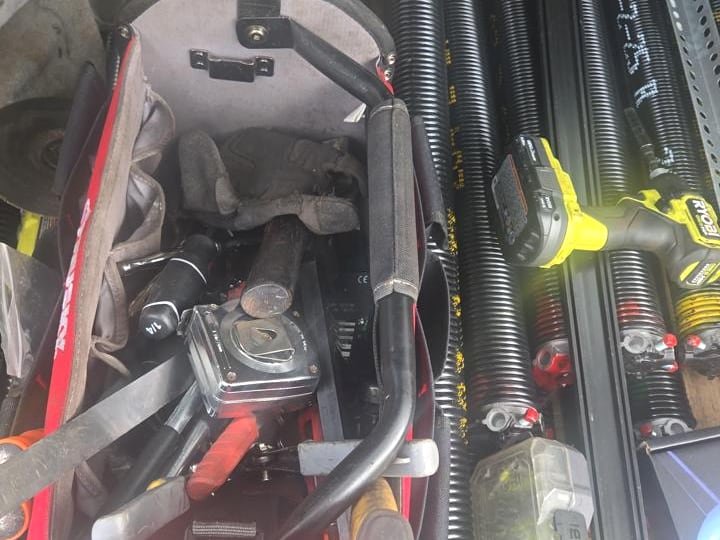
If the door will not hold its position, stop using the opener and call a technician. A torsion spring that has broken cannot hold the door's weight, and no amount of cycling will fix it. Do not attempt to move the door by hand or to pull the emergency release to test it. That is technician work, and it is the point at which a door can come down unexpectedly.
Sloped driveways, low headroom, and the opener
Many rural and older properties have a driveway that sheds toward or away from the opening, and a garage with lower headroom than a modern build. A sloped approach means the door does not travel against a level surface, and the opener and springs carry the load unevenly over time. Low headroom changes how the door tracks and how much room the opener has to work with.
If the opener motor runs but the door does not move, a stripped gear is one possible cause. It is not the only one. A broken spring, a snapped cable, or a door that has come off its track can all produce a door that stays put while the motor turns. The test that separates them is a technician's inspection of the springs, cables, and drive train, not a guess from the driver's seat.
What to check safely, and what to leave alone
From outside the door, with the garage empty, you can note whether the door sits crooked, whether there is a gap along the top, whether it feels heavier in normal use, and whether it makes a new noise. You can also keep the area around the door clear and make sure the opener's safety features are working as they should. A blocked or misaligned photo-eye will reverse a door that is closing, and only while it is closing. If a door reverses before it reaches the floor, that points to a travel-limit or force setting rather than the photo-eye.
Everything involving the springs, cables, and opener drive train belongs to a technician. That includes checking balance, adjusting tension, and moving the door by hand. If you are in Auburn, Kent, Federal Way, Renton, Tacoma, Puyallup, Seattle, Enumclaw, Maple Valley, Covington, Bonney Lake, Sumner, or the surrounding area and something about your door has changed, Liv Garage Door Repairs & Service can take a look. Reach the team at (425) 386-7589 or info@livgaragedoors.com. Weekday hours are 7:00 AM to 8:00 PM, Sunday is emergency service only, and 24/7 emergency dispatch is available.