A puddle at the garage door threshold is one of the most common wet-season complaints we hear across Auburn, Kent, Federal Way, Renton, and the surrounding suburbs. Sometimes it is a thin film that creeps a few inches inside after a long rain. Sometimes it is a standing pool that soaks the bottom of stored boxes. Water at the threshold has several possible causes, and they are not interchangeable. A worn bottom seal, a driveway that sheds water toward the opening, and a door that no longer closes fully all produce a wet floor, and each one calls for a different fix. This article covers what you can safely observe from outside the door with the garage empty, which causes are most likely, and which parts of the job belong to a technician.
What you can see without touching the door
Most of the useful information is available from the driveway, with the door closed and the garage empty. You are not inspecting the hardware; you are noting what the door looks like as a whole and where the water ends up.
- Does the door sit square in the opening, or is one side of the bottom edge higher than the other?
- Is there a visible gap along the top of the door on one side?
- After a steady rain, where is the water standing on the apron in front of the door?
- Does the wet band inside the garage match the width of the door, or does it appear along a wall instead?
- Does the door feel heavier than it used to when you use it normally?
- Is there a new noise at the start of a cycle?
Those observations narrow the problem down considerably. The technician inspects the bottom seal, the hinges, the rollers, and the cables directly, and can tell you which of them has actually changed.
The bottom seal is the first thing a technician checks
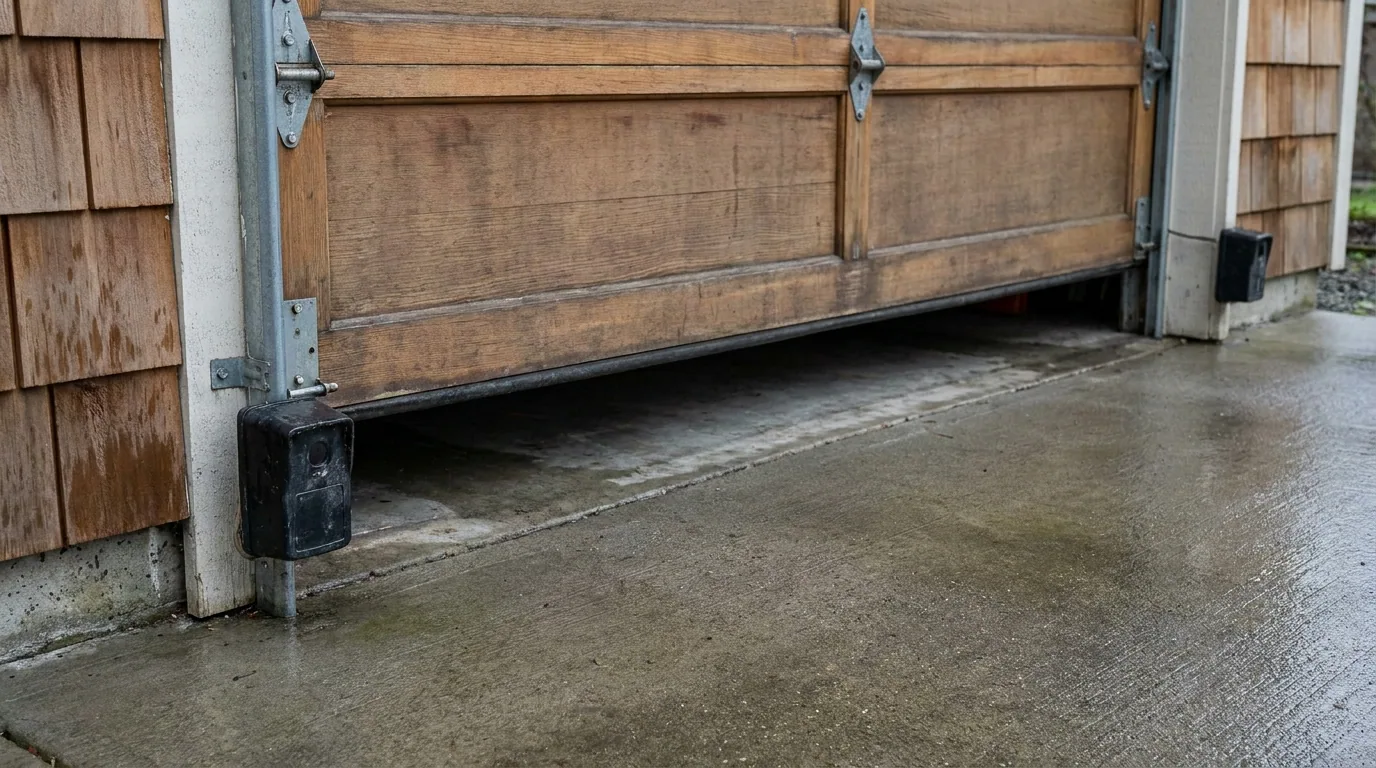
The bottom seal is the rubber or vinyl strip that runs along the lowest panel and meets the floor. It takes more wear than any other seal on the assembly. Over time it flattens, hardens, or tears away at the ends, and a seal that has gone flat no longer presses against the concrete. Water that reaches the door on a windy day will find that gap.
A technician can confirm in a few minutes whether the seal is still doing its job, whether it has pulled loose at one end, and whether the bottom panel itself has taken on water. Replacing a flattened or torn seal is straightforward work. What we would rather you not do is pry at the seal or the bottom panel yourself to see how much give it has; the bottom section carries the lift hardware, and it is easy to disturb an alignment that was fine.
If the seal turns out to be sound and water still gets in, the problem is somewhere else, and the next two sections are where to look.
The driveway slope is often the real culprit
Many driveways in this region are sloped, and some slope toward the house rather than away from it. That is a grading question, not a door question, and no seal will keep out water that is running downhill into the opening. You can sort this out without touching the door: after a steady rain, note where the water is standing. If the puddle sits on the apron in front of the door and the floor inside is wet in a band that matches the door's width, the water is arriving from outside and pooling against the door.
There are a few things that can help short of regrading the driveway. A threshold seal that sits on the concrete in front of the door and rises to meet the bottom seal gives water a taller barrier to climb. A shallow channel drain across the apron, cut in front of the door, catches water before it reaches the opening. Both are jobs for a technician or a drainage contractor, and both are worth discussing before the wet season rather than during it.
If the floor inside is wet but the apron in front of the door is dry, the source is probably not the door at all. A roof leak, a failing foundation joint, or water wicking through a wall can all show up as a puddle that looks like it came under the door. In that case the door is a bystander, and the fix is on the building side.
When the door itself is not closing all the way
A door that stops an inch or two short of the floor leaves a gap along the whole width, and water will find it. This is a separate problem from a worn seal, and it has several possible causes. The travel limits on the opener may be set so the door stops early. The close-force setting may be too low, so the door reverses before it reaches the floor. Something may be obstructing the track or the rollers. A door that reverses before it reaches the floor is a travel-limit or force-setting problem, not a photo-eye problem; the photo-eye is a safety device on the closing travel and reverses a door that is already on its way down when something blocks the beam.
What you can observe safely is the pattern of the cycle. Watch the door close from outside, with the garage empty. Does it reach the floor and stop, or does it stop short and stay there? Does it touch the floor and then reverse? Does it reverse before it gets close? Each of those points to a different setting or component, and a technician can sort out which one applies. Do not adjust the limits or the force setting yourself, and do not reach into the track to clear anything while the door is on the move.
Wooden doors, steel hardware, and a wet season that lasts
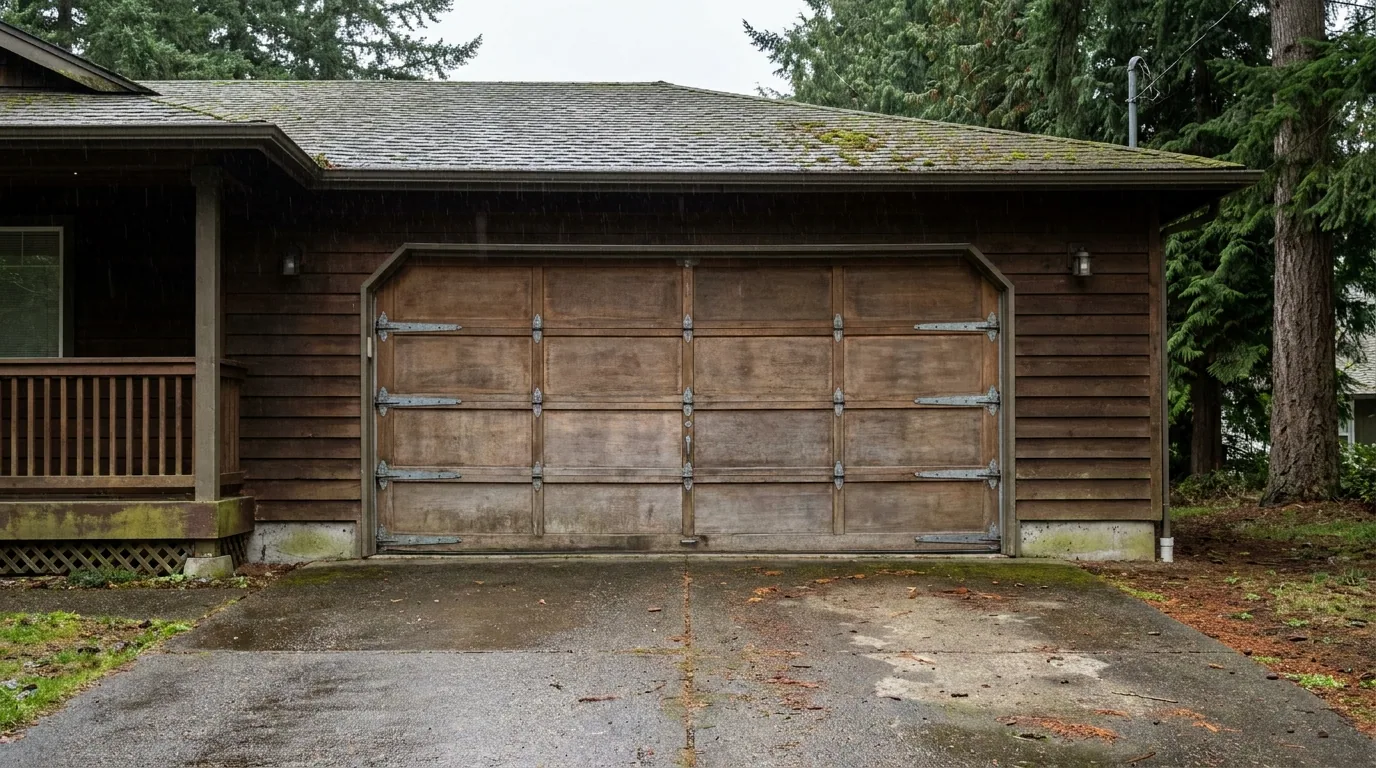
This part of Washington stays damp for months, and that has consequences for the door itself. A wooden door can swell at the bottom panel and the bottom rail, which changes how the door sits in the opening and can lift the seal off the floor. Steel hinges and rollers rust, and a hinge that has stiffened can keep a panel from seating evenly. These are hardware problems, and they belong to a technician; do not try to free a stiff hinge or adjust a panel yourself, and do not touch the springs or cables under any circumstances.
What you can watch for from outside is the door sitting crooked in the opening, a gap along the top that is wider on one side, the door feeling heavier than it used to in normal use, or a new noise at the start of a cycle. Any of those, combined with water at the threshold, is a good reason to have the door looked at as a whole rather than just the seal.
What to do before the next storm
If you have water at the threshold, the practical order is to note where the water is pooling on the apron, watch whether the door closes fully to the floor, and note anything about the door that has changed: sitting crooked, a wider gap along the top, feeling heavier, or a new noise. Those observations will tell a technician most of what they need to know before they arrive. If the seal is the problem, it can be replaced. If the slope is the problem, a threshold seal or a channel drain can help. If the door is not closing fully, that needs to be diagnosed before anything else.
If you are in Auburn, Kent, Federal Way, Renton, Tacoma, Puyallup, Seattle, Enumclaw, Maple Valley, Covington, Bonney Lake, or Sumner and want the door looked at, you can reach Liv Garage Door Repairs & Service at (425) 386-7589 or info@livgaragedoors.com. The address is 5548 34th St SE, Auburn, WA 98092. Hours are Monday through Saturday, 7:00 AM to 8:00 PM, with Sunday emergency service only and 24/7 emergency dispatch.