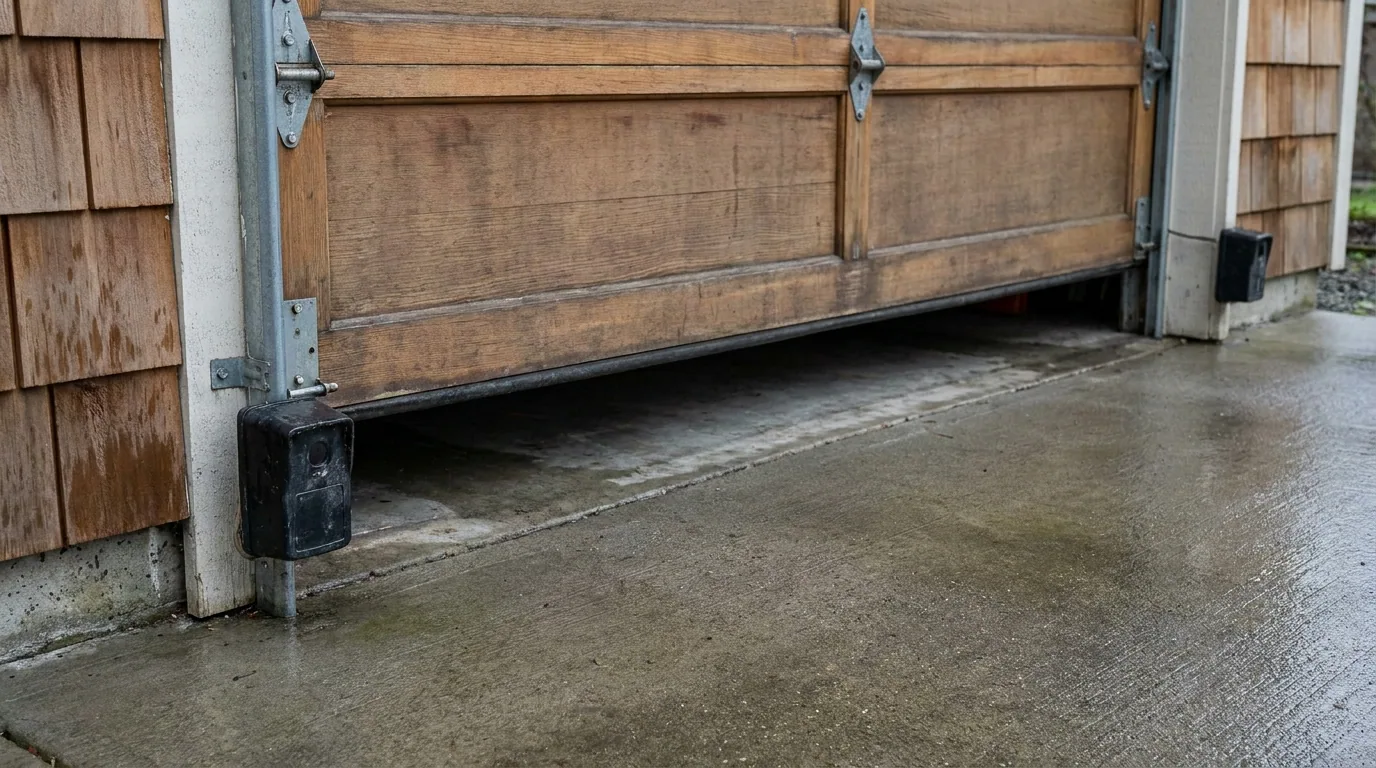
The two small units mounted near the floor on either side of the opening are the most misunderstood parts on a garage door. They are called photo-eyes, and they exist for one job: to stop and reverse a door that is traveling down when something breaks the beam between them. That is the whole of their responsibility. When a door will not start at all, opens a few inches and goes back up, or stops short of the floor, the photo-eyes are usually not the cause, and time spent replacing them is time wasted. The useful skill is knowing which symptom actually belongs to the eyes and which points somewhere else.
What the photo-eyes do, and when they matter
A photo-eye is a safety device on the down travel only. One unit sends an invisible beam across the opening; the other receives it. While the door is closing, if anything interrupts that beam, the opener reverses the door. That is the entire function.
So the symptom that belongs to the photo-eyes is narrow and specific: the door is on its way down, and it reverses before it reaches the floor. If your door reverses in that situation, the eyes are a reasonable place to start. If your door does something else, read the next section before you touch anything.
Two conditions have to be true for the eyes to work. The beam has to be unobstructed, and the two units have to be aimed at each other. A box, a broom, or a bag of soil sitting in the path will trigger a reversal every time. So will a unit that has been knocked out of alignment by a bump from a bike, a trash can, or a car bumper.
Symptoms that are not photo-eye problems
This is where most misdiagnosis happens. Three common complaints get blamed on the eyes when the eyes have no role in them:
- The door will not start at all. The photo-eyes do not prevent a door from opening. A door that does nothing when you press the button points to the opener, the power supply, or the wall control.
- The door opens a little, then reverses. This is a travel-limit or force-setting problem, not a safety-beam problem. The opener thinks it has hit something on the way up, or its open limit is set wrong.
- The door stops short on the way down but does not reverse. Again, travel limits and force settings. The eyes would reverse the door, not park it.
If your door is doing one of those three things, the eyes are not the place to look, and replacing them will not change the behavior.
What you can safely check yourself
Everything in this section is done standing on the floor, with the door closed and the opener unplugged or the breaker off. None of it involves the springs, the cables, or the opener drive train.
- Clear the path. With the garage empty of people and pets, walk the opening and make sure nothing sits between the two eyes. Look for a stored item, a recycling bin, or a shovel leaning into the beam.
- Check that both units are present and facing each other. Each eye should be mounted at roughly the same height on its bracket, pointed straight across the opening. A bracket that has been bent, or a unit hanging loose, is a likely culprit.
- Wipe the lenses. Dust, cobwebs, and the film that builds up over a wet winter can dim the beam. A dry cloth on the lens face is enough.
- Check the indicator lights. Most photo-eye units have a small light on each. The behavior of those lights varies by brand, so check your opener's manual rather than guessing. A light that is off or flickering on one side while the other is steady is worth noting for the technician.
- Check the wiring you can see. The thin low-voltage wire runs from each eye back to the opener head. Look along its length for a spot where it has been pinched by a door track, chewed, or pulled loose at the terminal. Do not disconnect anything; just note what you see.
If clearing the path, straightening a bracket, and wiping the lenses fixes the reversal, you are done. If the door still reverses with a clear path, stop there.
When to call a technician
Call for service when the path is clear, both units are mounted and aimed, and the door still reverses during the close cycle. That points to a failed eye, a break in the low-voltage wire you cannot see, or a problem at the opener's terminals, and sorting those apart takes a meter and access to the head unit.
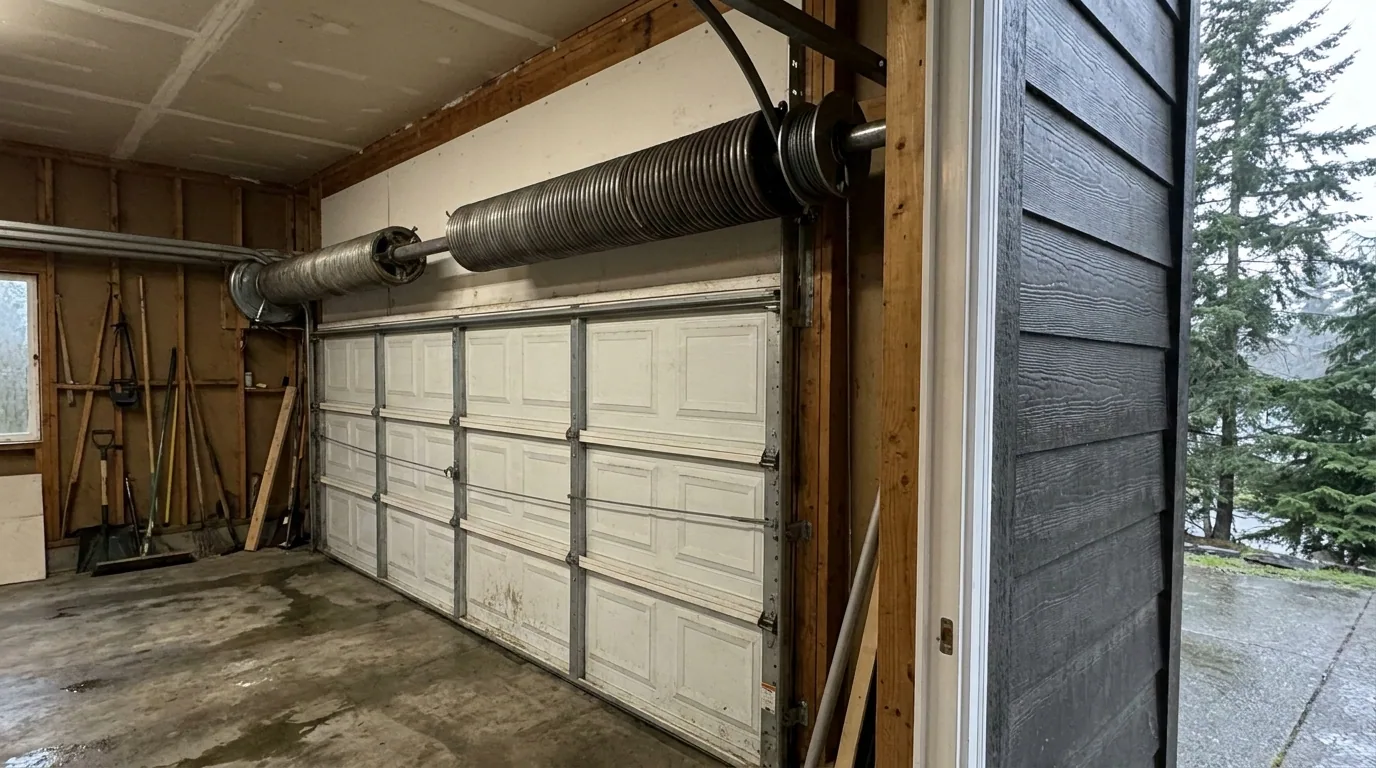
Call as well if the door is doing something the eyes cannot cause: refusing to start, reversing on the way up, or stopping short. Those are travel-limit, force-setting, or opener problems, and they need to be adjusted rather than guessed at. And call if you notice the door sitting crooked in the opening, a gap along the top when it is closed, or a new noise at the start of a cycle. A crooked door can come from a snapped cable, a broken spring, or a bent track, and a technician can tell which by inspecting the springs, cables, and track directly. None of that is homeowner work.
Liv Garage Door Repairs & Service handles photo-eye diagnosis, opener repair, and safety inspections across Auburn and the surrounding service areas. The shop is at 5548 34th St SE, Auburn, WA 98092, open Monday through Saturday from 7:00 AM to 8:00 PM, with emergency dispatch on Sundays and around the clock. Reach the team at (425) 386-7589 or info@livgaragedoors.com. The company is a registered Washington State contractor.