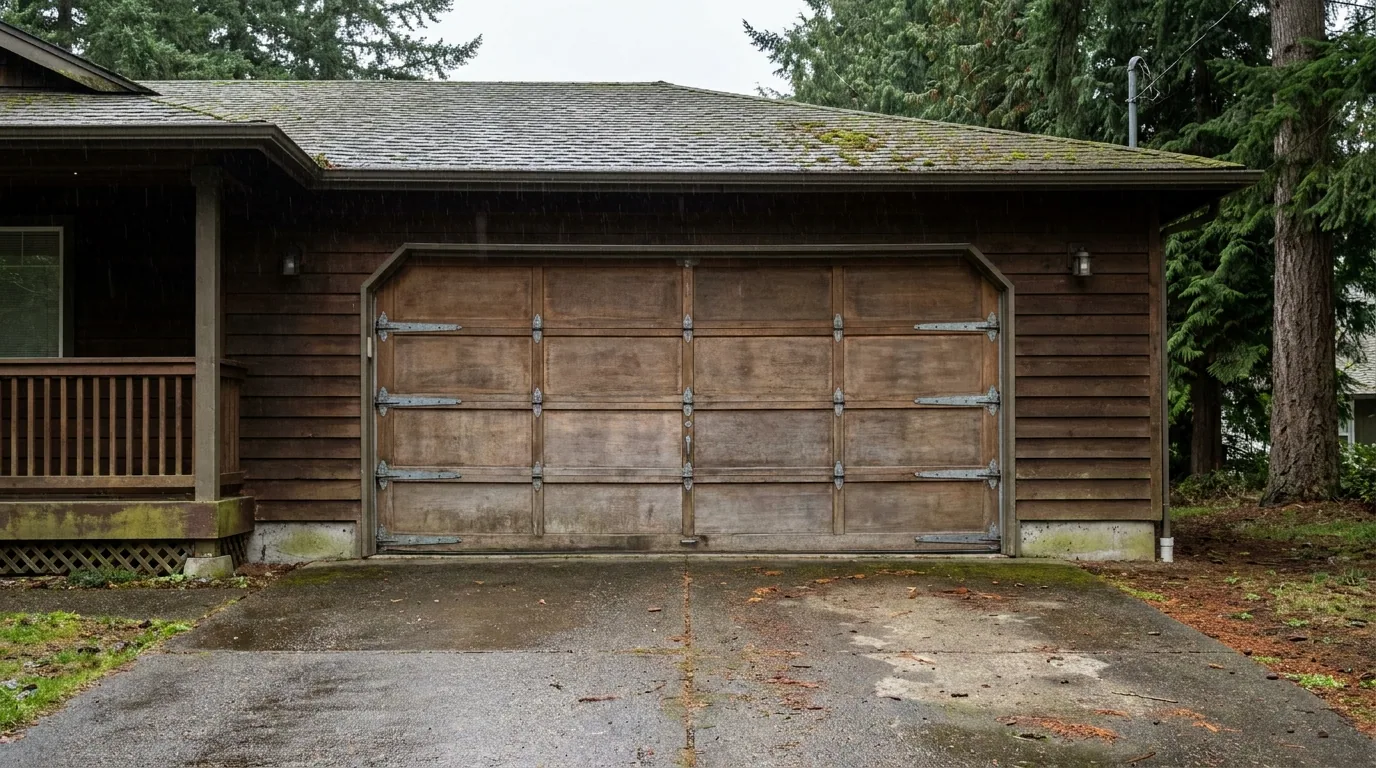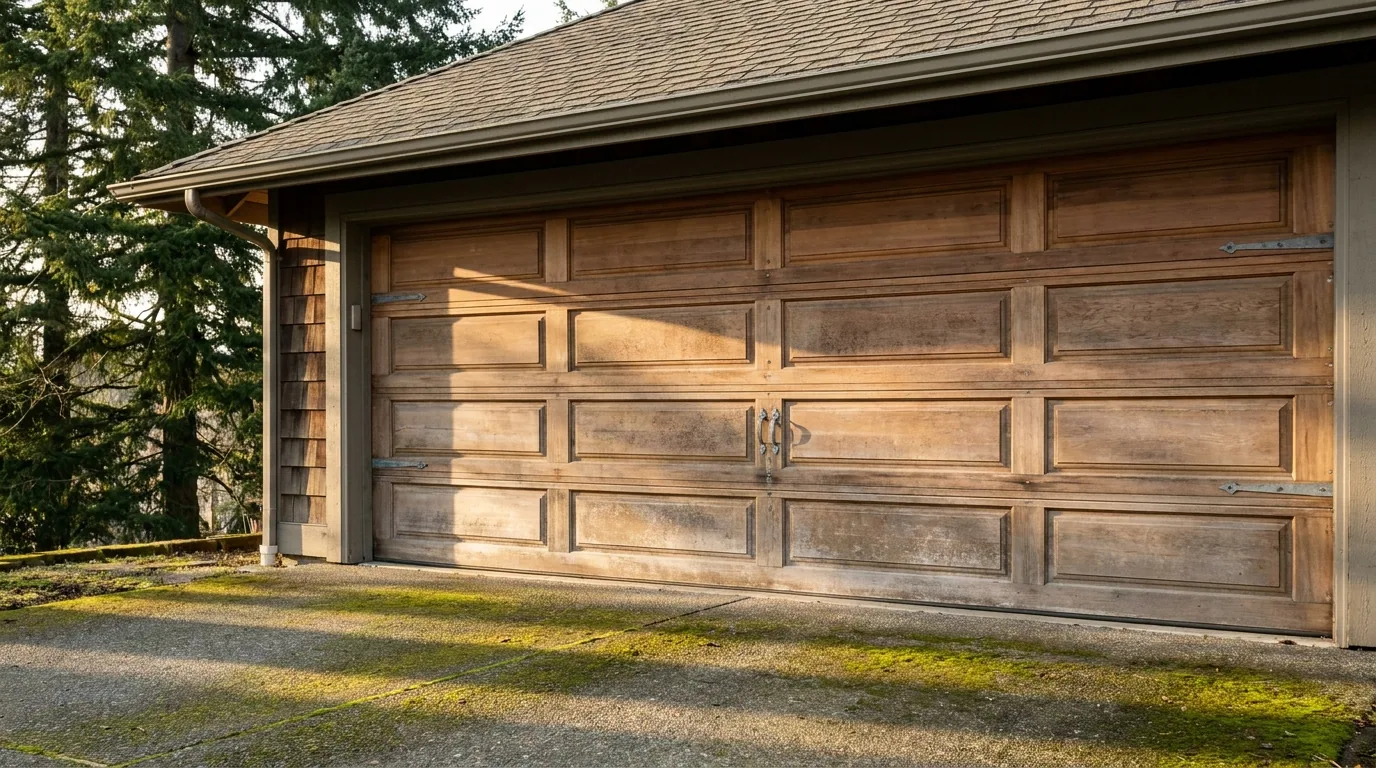
Wooden garage doors are common on the older homes around Kent and the surrounding suburbs, and every wet season they behave a little differently than they did in summer. The door that ran smoothly in September starts to drag, binds partway down, or needs a second press of the button to get moving. Homeowners often assume the springs are going. On a wooden door in this climate, that is rarely the first place to look. Wood takes on moisture from the damp air and from the concrete it sits above, and it moves as it does so. The result is a door that has changed shape slightly, and a set of hardware that now has to work against it.
What swelling actually does to a sectional door
A wooden sectional door is made of panels, and each panel is edged, jointed, and hinged to its neighbors. Wood is not dimensionally stable. As it absorbs moisture from months of steady rain and air that never fully dries out, it expands, mostly across the grain. That expansion shows up in a few predictable places:
- At the panel edges. Panels grow slightly wider and taller, and the gaps between them close up. A door that had a clean line between panels in August can be tight against itself by December.
- At the hinges. The hinge leaves are fastened to wood that has moved. Joints that pivoted freely can start to bind as the panels press against each other.
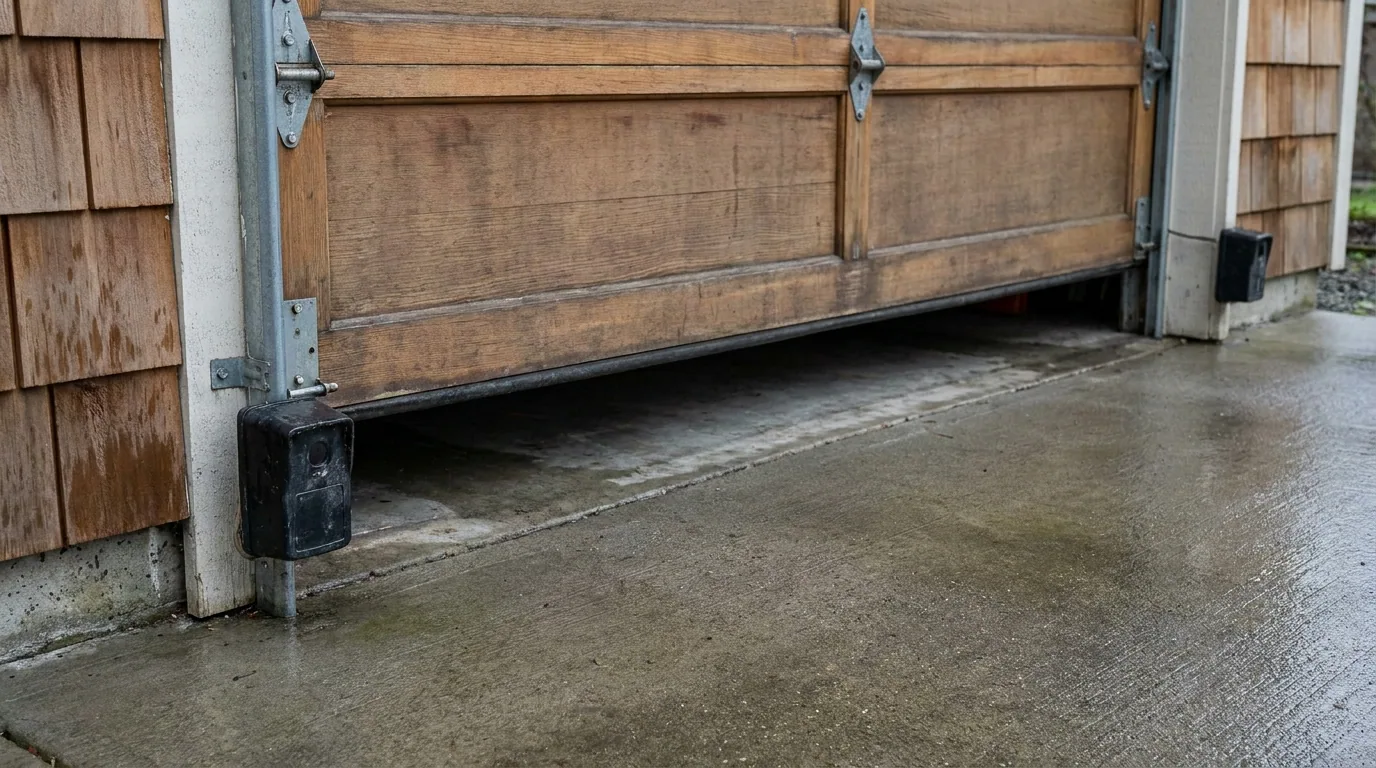
- At the bottom seal. The bottom section sits closest to the wet concrete, and it takes on the most moisture. A swollen bottom panel can drag on the floor or catch on the frame.
- At the frame and stops. The wooden jambs and the stops the door closes against swell too, narrowing the opening the door has to travel through.
None of this is a failure of the door. It is wood doing what wood does in a damp climate. The problem is that the opener and the springs are set up for the door as it was, not as it is now.
Start with what you can see and hear from outside the door
Before anything else, watch and listen to a full cycle with the garage empty and nothing in the door's path. You are not inspecting the springs or cables; that is technician work. You are gathering symptoms that narrow the list.
- Does the door sit crooked? One side higher than the other at rest, or a visible gap along the top on one side, points to a problem in the lifting hardware. A snapped cable will let a door hang at an angle, and a broken torsion spring cannot hold the door's weight. Both need a technician.
- Does it bind at the same point every time? A door that catches at one height and then continues is usually dragging on something: a swollen panel against the frame, a stiff hinge, or a bottom seal catching on the floor. A door that stalls at a different point each time is a different problem.
- Does it feel heavier in normal use? If the door is noticeably harder to move than it was, the cause could be added friction from swollen wood and stiff joints, or it could be the spring system. Those are separated by a technician, not by hand.
- Is there a new noise at the start of the cycle? A squeal or a groan can come from a dry hinge, a dry roller bearing, or a panel rubbing the frame. The location of the sound, not its pitch, is what tells them apart.
Why the opener strains first
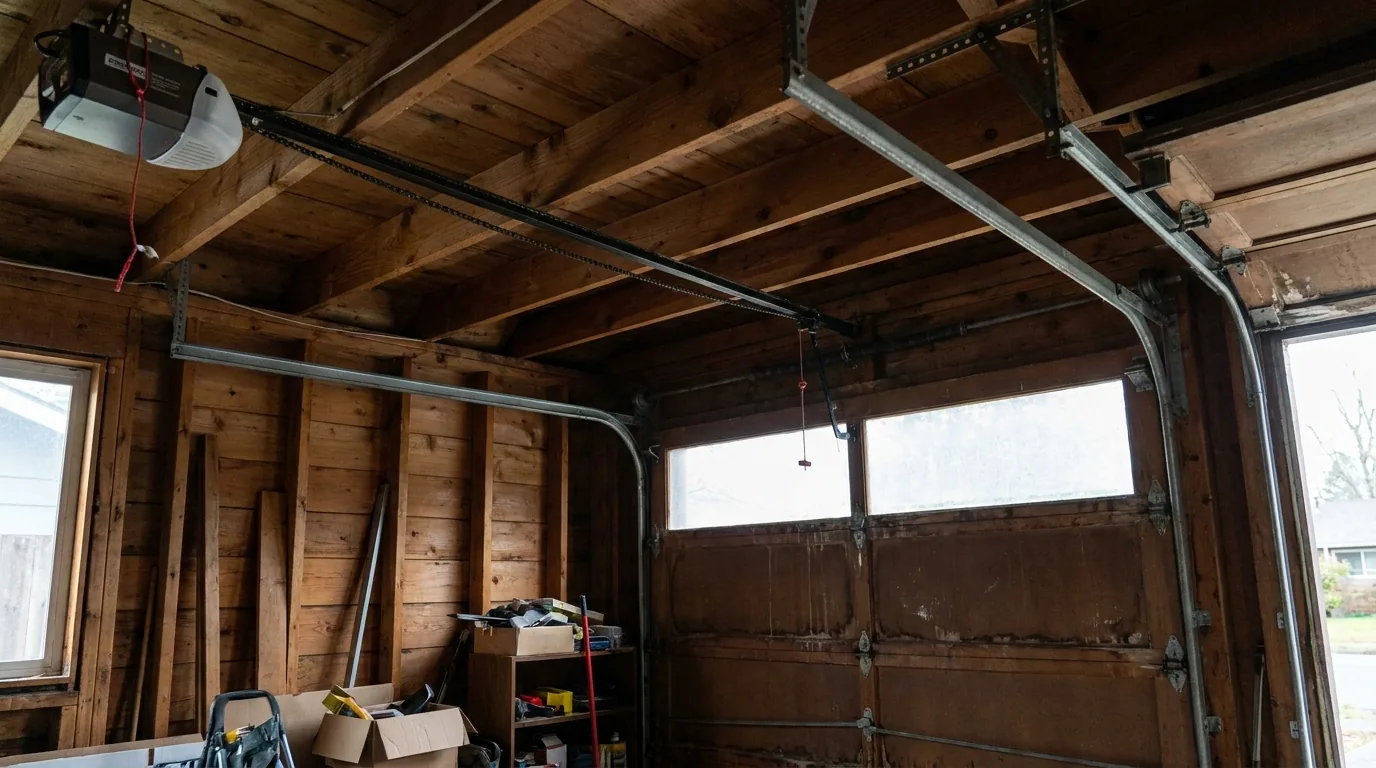
The opener does not lift the door on its own. The springs carry most of the weight, and the opener moves what is left. When swollen wood and stiff hinges add friction, the opener is the part that reports it: it sounds labored, it hesitates, or it stops and reverses partway through the cycle.
A door that reverses before it reaches the floor is a travel-limit or force-setting problem. The safety photo-eye is a device on the closing travel only; a blocked or misaligned eye reverses a door that is on its way down, and it has no role in a door that will not start or that stops short on the way up. If your door goes up fine and reverses on the way down, the limit and force settings are where a technician will look first, along with the condition of the bottom seal and the frame.
What a tune-up covers in the wet months
A tune-up and safety inspection on a wooden door in this climate is mostly about the parts that move and the parts that touch the ground. A technician will check the spring system and cables, adjust the travel limits and force settings on the opener, lubricate the hinges and rollers, and check that the bottom seal is sitting correctly rather than dragging. On a door that has swelled, some of the binding can be relieved by adjusting the track and the stops; if a panel has taken on enough moisture to be permanently out of shape, panel replacement is the alternative to living with a door that binds every winter.
If the door has started to catch, hesitate, or hang crooked, it is worth having it looked at before the wet season is in full swing. Liv Garage Door Repairs & Service works on residential and commercial doors across Auburn, Kent, Federal Way, Renton, Tacoma, Puyallup, Seattle, Enumclaw, Maple Valley, Covington, Bonney Lake, and Sumner. The phone number is (425) 386-7589, and the shop is at 5548 34th St SE, Auburn, WA 98092. Weekday hours are 7:00 AM to 8:00 PM, Monday through Saturday, with emergency service only on Sunday and 24/7 emergency dispatch.
What not to do yourself
Torsion springs, cables, and the opener drive train are not homeowner work. A torsion spring under tension can release violently, and a cable that has snapped or come off its drum leaves the door in an unstable state. Do not pull the emergency release to move the door by hand, and do not try to test the balance yourself. Describe what you see and hear, and let a technician take it from there.