Every fall, the calls that come in about garage door noise follow a pattern. The door was quiet through the dry months, then the first stretch of steady rain arrives and it starts to squeal, grind, or groan somewhere along its travel. In Auburn and the surrounding suburbs, where the wet season runs for months rather than weeks, that timing is not a coincidence. Steel rollers, hinges, and the pivot points between panels are the parts most exposed to damp, and they are usually the first things on a door to announce themselves. This article covers what wet-season rust actually sounds like, how to tell it apart from noises that point to something else, and which of those you can deal with yourself.
Why the noise shows up when the rain does
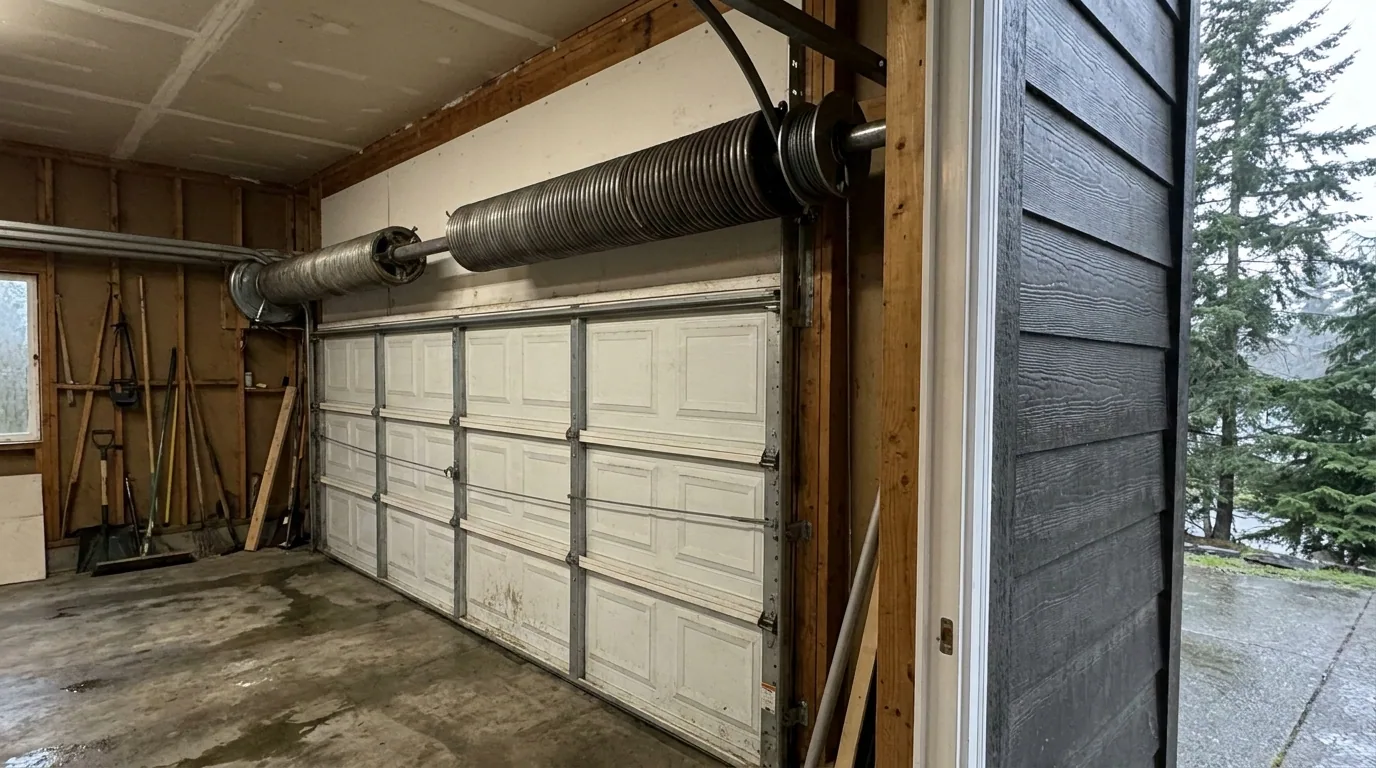
A sectional door is a collection of steel parts that pivot against each other every time it opens and closes. The rollers turn inside their hinges, the hinges pivot between panels, and each of those contact points carries a thin film of lubricant. Through a dry summer, that film holds. Through months of damp air sitting in an unheated garage, bare or thinly coated steel can begin to oxidize. Once a roller's bearing surface or a hinge pin starts to corrode, it no longer turns freely, and a part that should rotate quietly starts to drag and scrape instead.
That is the mechanism behind the classic wet-season noise, and it is also why the sound often seems to arrive overnight. The corrosion has been building quietly for weeks, and the noise starts once enough of it has accumulated to change how the part moves.
What rust on rollers and hinges sounds like
The sound itself is fairly consistent, and it helps to know what you are listening for.
- A high squeal or chirp that repeats at the same point in the door's travel, usually as the door passes a particular height. That repetition points to a specific roller or hinge rather than the whole track.
- A grinding or gritty rumble that runs the length of the cycle. This is the sound of a roller that has stopped turning and is being dragged along the track, or of a bearing surface that has corroded solid.
- A creak or groan at the start of the cycle, as the opener takes up the load and the panels begin to move against each other.
- A scrape that gets louder in one direction, often on the way down, when the door's weight is being lowered rather than lifted.
One useful observation from outside the door, with the garage empty: watch the door as it moves and note whether the noise tracks a particular height or happens throughout. A noise tied to one spot in the travel is a narrower problem than one that follows the whole cycle.
When the noise is not rust
Rust is a common explanation for a wet-season squeal, but it is not the only one, and it is worth being honest about that. A squeal can come from a dry hinge pin, a roller with a worn bearing, a roller that has jumped its track slightly, or a hinge that has loosened. A grinding sound can come from a corroded roller, but it can also come from a roller worn flat on one side, or from a track that has been dented or pushed out of line. The noise alone does not separate those.
There is a simple way to narrow it down without touching anything. Note whether the noise is constant or intermittent, whether it changes with the weather, and whether it comes with anything else: the door sitting crooked in the opening, a gap along the top edge, the door feeling heavier than usual in normal use, or the opener straining. A noise on its own, with the door running straight and level, usually points to hardware that needs attention. A noise alongside any of those other symptoms points to something a technician should look at before the door is used much more.
What you can do, and what belongs to a technician
The safe homeowner work here is limited but real. Keeping the garage as dry as you reasonably can, by clearing standing water, keeping the door closed in driving rain, and letting the space ventilate on dry days, slows the corrosion that causes the noise. A technician will lubricate the rollers, hinges, and pivot points with the right product for the hardware, and will check that each roller turns freely in its hinge and that the hinges are tight.
What you should not do is take the door's moving hardware apart. Rollers, hinges, and the brackets that hold them are under the door's weight and spring tension, and a part that comes free under load can drop the door. The same applies to the springs and cables: those are technician work, always. If a roller has seized or a hinge has pulled loose, the door should be left closed until it can be looked at.
When to call it in
A wet-season squeal that quiets down after a dry spell is usually hardware asking for lubrication and a look. Call it in if the noise comes with the door sitting crooked, a gap along the top, the door feeling heavier in normal use, a new bang or snap, or an opener that runs without moving the door. Those combinations point to causes that need to be separated by someone with the door in front of them. A snapped cable, a broken spring, a bent track, or a stripped opener gear can all produce a door that behaves oddly, and the test that tells them apart is not one to run yourself.
If you are in Auburn, Kent, Federal Way, Renton, or anywhere else in the surrounding service area and the noise has come with the rain, Liv Garage Door Repairs & Service can take a look. Reach the team at (425) 386-7589 or info@livgaragedoors.com. Weekday hours are 7:00 AM to 8:00 PM, Sunday is emergency service only, and 24/7 emergency dispatch is available.