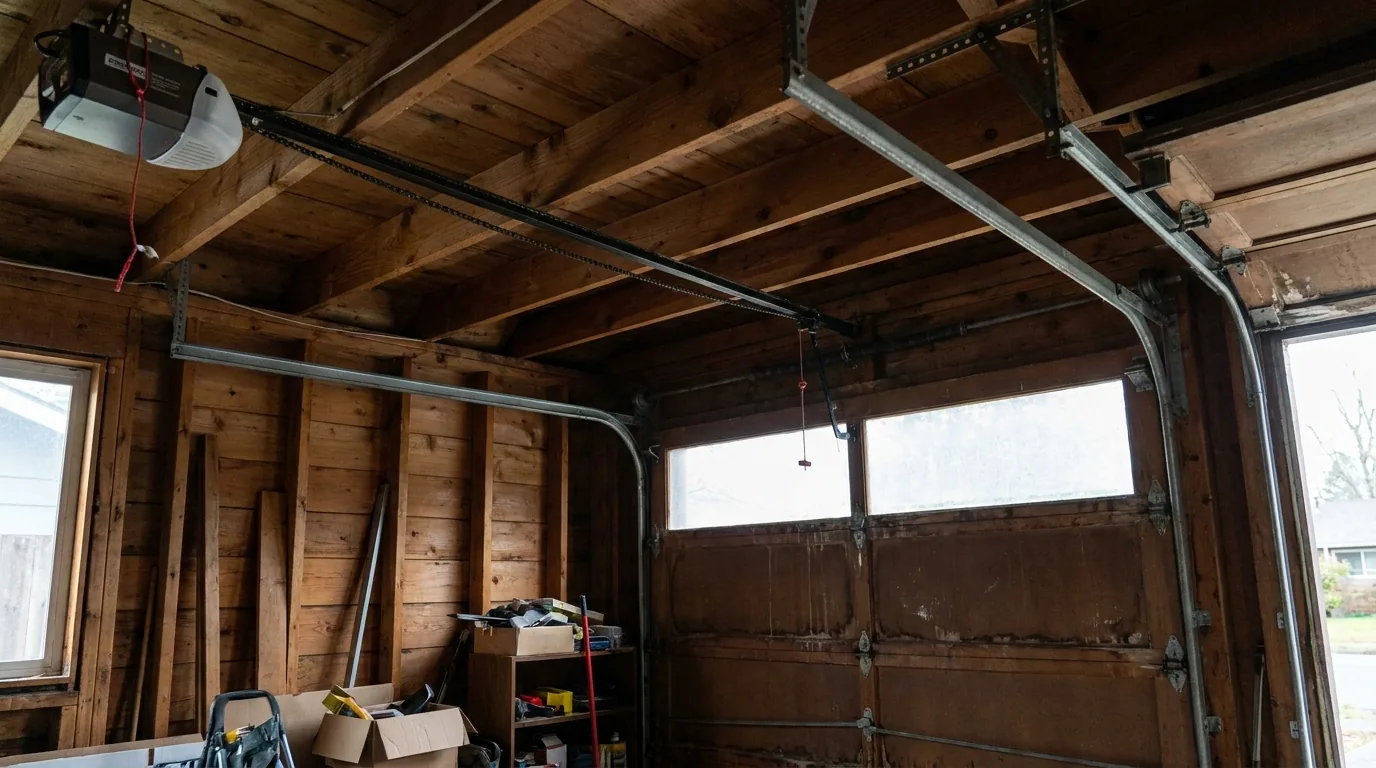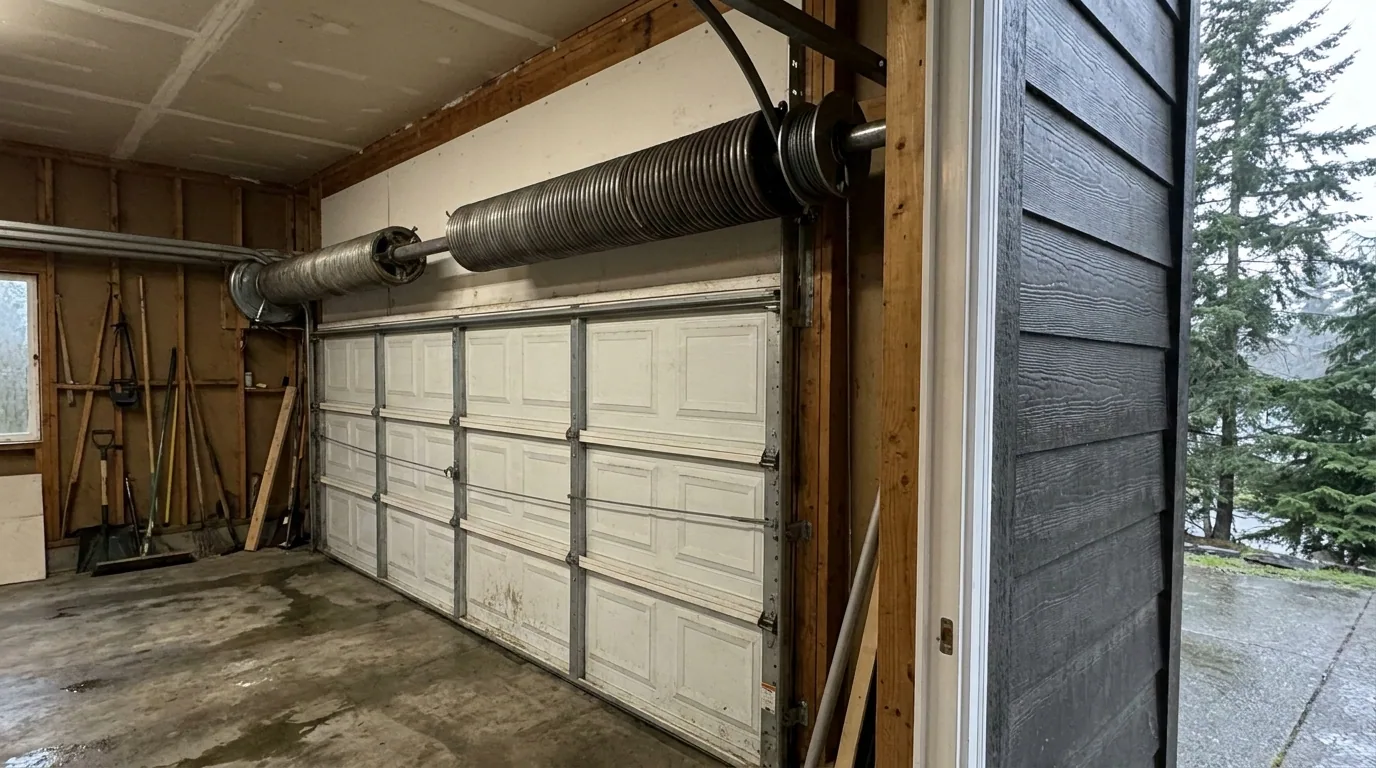
Anyone who has spent a winter in Auburn or Kent knows the pattern: rain for days, a short break, then more rain, and a garage that never quite dries out. The concrete slab stays dark, the air inside feels heavier than the air outside, and a door that was quiet in August starts to groan by December. This is not a sign that something is wrong with the house. It is what months of steady damp do to the steel and wood parts of a garage door. This article covers where the moisture comes from, which parts of the door it attacks first, what you can safely observe from the driveway, and which work belongs to a technician.
Where the moisture in a garage actually comes from
A garage is usually the least climate-controlled room on the property. It has a thin or uninsulated door, a concrete slab poured directly on grade, and often vents or gaps that let outside air move through. In western Washington, that outside air carries a lot of water for much of the year.
Two sources matter most. The first is the slab. Concrete is porous, and ground beneath it stays wet through the rainy months, so the slab can hold moisture and release it slowly into the air inside the garage. The second is the door opening itself. Every time the door cycles, a wide opening exchanges inside air for outside air, and the bottom seal is the only barrier when the door is closed. If that seal is worn, damp air moves freely under the door.
Low-lying ground and shaded lots hold that moisture longer than open, sunny ones, but the mechanism is the same everywhere: wet ground, a porous slab, and a door that is not airtight add up to a garage that stays humid well past the last storm.
Hinges and rollers feel it first
The steel hinges and rollers are the parts of a sectional door most exposed to moist air. Each hinge pivots on a pin, and each roller turns on a bearing surface inside its bracket. Those contact points depend on a thin film of lubricant to keep metal from grinding on metal. When the air stays damp for weeks at a time, that film can thin out or wash away, and bare steel begins to oxidize.
The usual first sign is noise: a squeal, a grind, or a groan at the start of a cycle that may ease as the door is used. A squeal can come from a roller, a hinge, or a dry bearing, and no one can tell which from the sound alone. A technician separates them by checking each pivot point in turn. What you can do safely is keep the garage as dry as you reasonably can, clear anything blocking vents, and make sure water drains away from the slab rather than pooling against it. Lubricating hinges and rollers is work to ask for during a tune-up.
Bottom seals, tracks, and wooden doors
The bottom seal is a rubber or vinyl strip that compresses against the floor to keep weather out. When it sits against concrete that stays damp for days after rain, the rubber can harden, crack, or pull away from the door. From outside, with the door closed, you may see daylight or a dark line of gap along the bottom edge. A worn seal lets more damp air in, which makes everything above it worse.
Wooden doors and wooden frames absorb moisture and swell. A door that swelled can rub where it used to clear, stick partway through its travel, or fail to meet the floor evenly. Steel tracks can also shift as the ground and framing move with the seasons, and a track that is slightly out of line will make the door drag.
What you can safely observe from the driveway
With the garage empty and the door closed, a few things are worth watching for. Does the door sit crooked in the opening? Is there a gap along the top edge where the panels no longer meet the header squarely? When you operate the door normally, does it feel heavier than it used to, or make a new noise at the start of a cycle? Does it leave a gap at the floor when it closes?
Those observations are genuinely useful when you call for service, because they narrow down where a technician should start. What you should not do is inspect springs or cables, or touch the opener drive train. A door that sits crooked can mean a snapped cable, a broken spring, or a bent track, and only a technician can tell which by examining the hardware. The same goes for a door that feels heavier in normal use: it has several possible causes, and identifying the right one is technician work.
Getting ahead of damp-related wear
Most of what damp does to a door happens slowly, which is why a periodic tune-up and safety inspection catches it before it becomes a repair. A technician inspects the springs and cables, checks the hinges and rollers, tests the balance and travel, and tells you whether the bottom seal or any panels need attention. If a door has already started to stick, squeal, or leave a gap, that is the point to have it checked rather than waiting for it to fail outright.
Liv Garage Door Repairs & Service handles residential and commercial garage door work in Auburn and the surrounding communities, including Kent, Federal Way, Renton, Tacoma, Puyallup, Seattle, Enumclaw, Maple Valley, Covington, Bonney Lake, and Sumner. The company is registered in Washington State. You can reach the office at (425) 386-7589 or info@livgaragedoors.com, and the address is 5548 34th St SE, Auburn, WA 98092. Hours are Monday through Saturday, 7:00 AM to 8:00 PM, with Sunday emergency service only and 24/7 emergency dispatch.