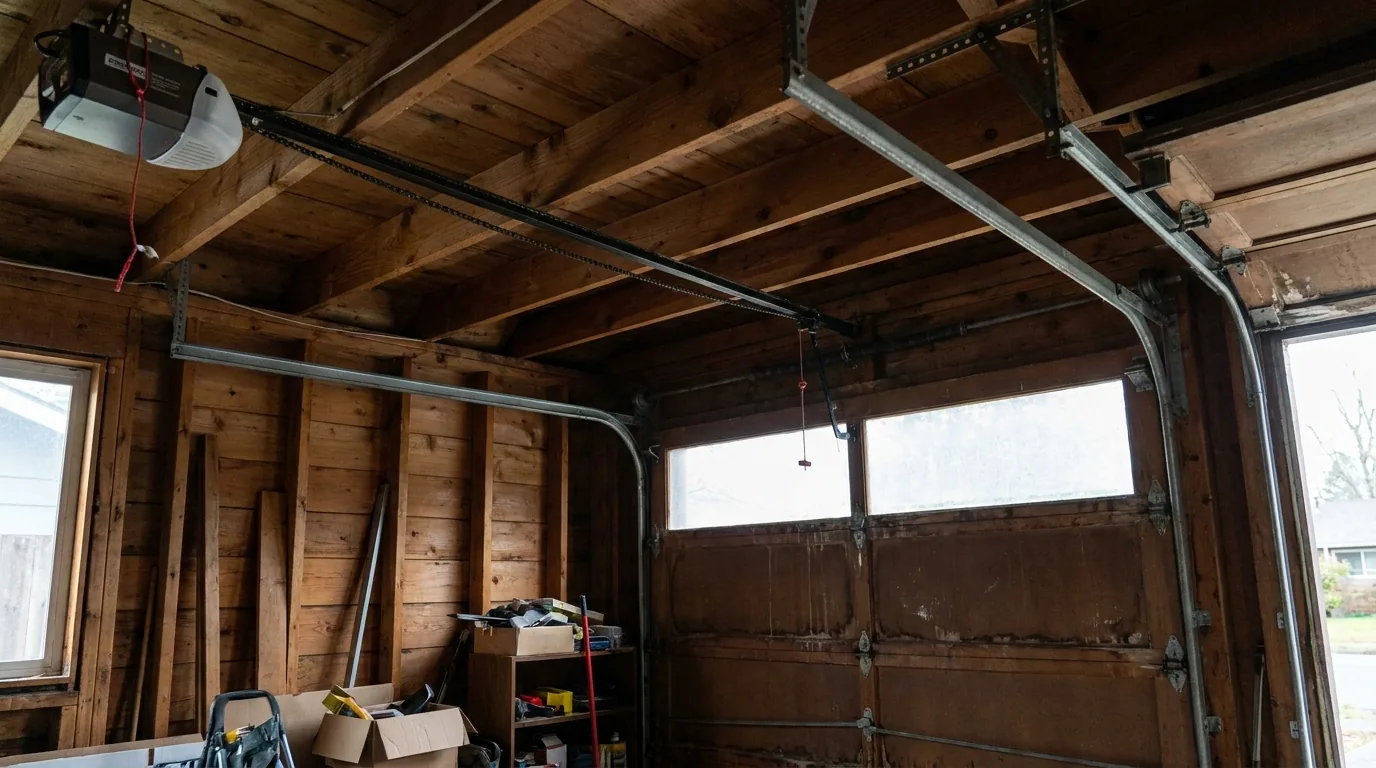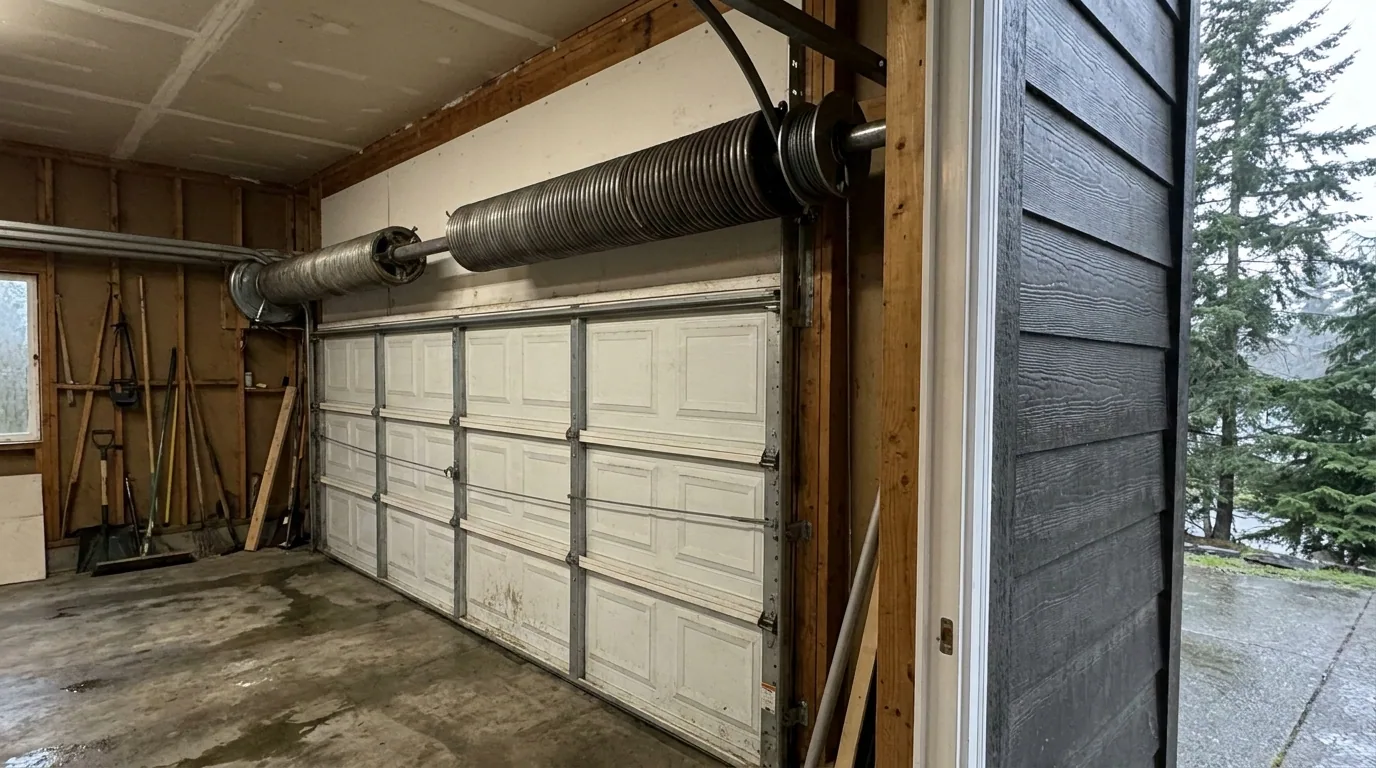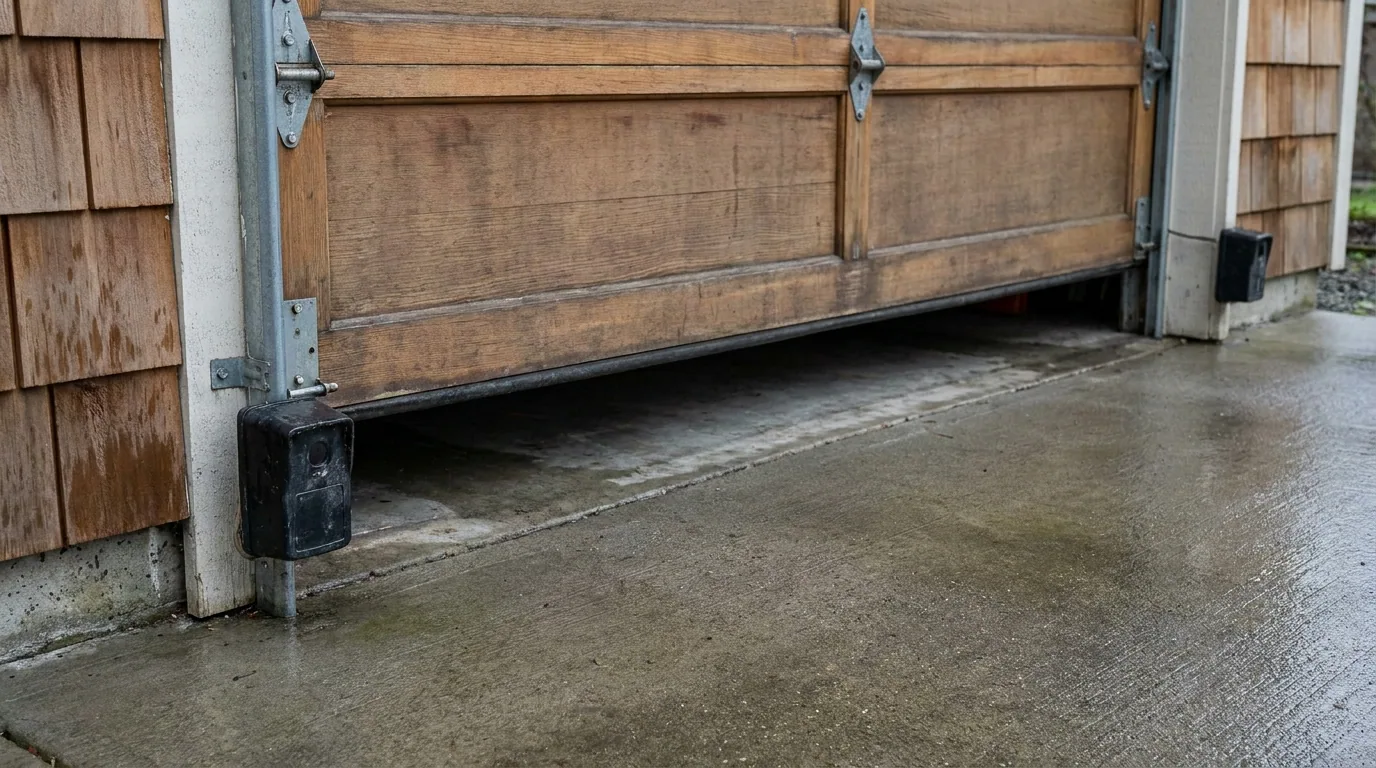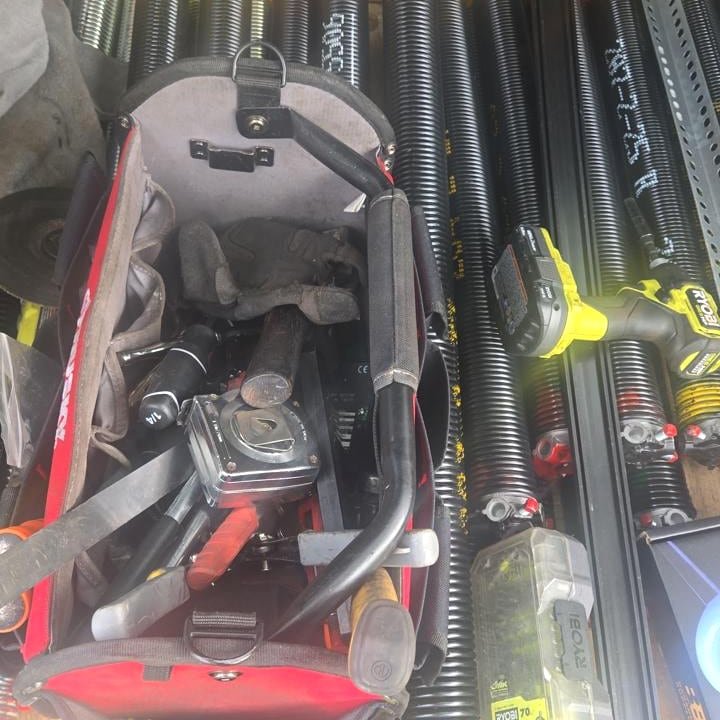
A low-headroom garage is one of the more common setups in older neighborhoods around Auburn and the surrounding suburbs: a detached single-car garage, a shallow ceiling, and a sectional door that has very little room to work with above the track. When a door in that kind of garage starts to feel heavy, moves slowly, or makes the opener work harder than it used to, the instinct is often to replace the motor with something bigger. That is usually the wrong place to start. The spring system is what carries the door's weight. The opener only moves a door that the springs have already made manageable, and a larger motor does not correct a spring system that is no longer doing its job.
What low headroom actually changes
Headroom is the distance from the top of the door to the ceiling, or to the lowest obstruction above the door. A standard door needs enough room for the track to curve back and for the door to travel up and over. A low-headroom garage has less of that space, so the door is fitted with a track configuration and a spring arrangement built for the tighter clearance.
The important consequence is that the spring system has to be matched to the door's actual weight and to the geometry of that specific opening. A spring that is too light for the door leaves the opener lifting weight the springs should be carrying. A spring that is too heavy for the door puts extra load on the door and the opener in the other direction. Neither problem is solved by a stronger motor. The motor is not the component holding the door up.
Why a bigger motor is not the answer
An opener is rated to move a door within a certain weight and balance range. When a door is properly sprung, the opener's job is small: it starts the door moving, guides it along the track, and stops it at the limits. When the springs are tired or mismatched, the opener ends up doing work it was never meant to do. It may still move the door for a while, but it runs hotter, the gear and drive train wear faster, and the door becomes harder to stop and reverse safely.
Putting a larger motor on an unbalanced door hides the symptom for a time. The door still is not properly supported, the springs still are not carrying their share, and the new motor is now absorbing the same excess load. The underlying problem is unchanged, and the wear simply moves to a more expensive component.
What you can notice from outside the door
You do not need to touch the springs, cables, or opener drive train to recognize that something in the system has changed. With the garage empty and the door closed, a few observations are useful:
- The door feels noticeably heavier when you use it normally, or the opener sounds like it is straining at the start of a cycle.
- The door sits crooked in the opening, with one side higher than the other.
- There is a visible gap along the top of the door when it is closed, or the door does not meet the floor evenly.
- A new noise appears at the beginning of a cycle that was not there before.
- The door opens partway and stops, or reverses before it reaches the floor.
Each of these points to a different part of the system. A crooked door can mean a snapped cable, a broken spring, or a bent track. A door that reverses before it reaches the floor is a travel-limit or force-setting issue rather than a photo-eye problem; a blocked or misaligned photo-eye reverses a door that is closing, and only while it is closing. A new noise at the start of a cycle can come from a roller, a hinge, or a dry bearing. The way to separate these is for a technician to inspect the springs, cables, rollers, and track directly.
What a technician checks on a low-headroom door
On a low-headroom door, the inspection starts with the spring system and how it is matched to the door. The technician checks the springs and cables, confirms the door's balance, and reviews the track and hardware for wear. In this region, months of rain and constant damp also rust steel hinges and rollers and swell wooden doors, so hardware and bottom seals often fail before the springs do. A low-headroom door with a rusted hinge or a swollen panel can feel heavy for reasons that have nothing to do with the spring, and the inspection needs to separate those causes rather than assume one.
If the springs are the issue, the correct fix is a spring matched to the door's weight and to the low-headroom geometry, installed by a technician. Torsion springs and cables are under high tension and are not homeowner work. The same applies to the opener drive train: adjusting or replacing it belongs to a technician.
When to call
If your door feels heavier than it used to, sits crooked, leaves a gap at the top, or makes a new noise at the start of a cycle, that is the point to have it looked at rather than to size up a bigger motor. Liv Garage Door Repairs & Service works on residential and commercial doors across Auburn, Kent, Federal Way, Renton, Tacoma, Puyallup, Seattle, Enumclaw, Maple Valley, Covington, Bonney Lake, and Sumner. The team is available Monday through Saturday from 7:00 AM to 8:00 PM, with Sunday emergency service only and 24/7 emergency dispatch. You can reach the office at (425) 386-7589 or info@livgaragedoors.com, or visit 5548 34th St SE, Auburn, WA 98092. Liv Garage Door Repairs & Service is a registered Washington State contractor.