A frayed garage door cable is easy to postpone. It is a thin braided steel line tucked behind the track, it does not announce itself the way a snapped spring does, and the door usually keeps working for a while. That is exactly what makes it worth talking about. A cable that is fraying has already lost part of its capacity to hold the door, and it does not heal. It progresses, and it tends to progress fastest on the days you use the door most. This is a plain description of what the cable does, how a worn one shows itself from outside the door, and why the cost of waiting is not really about the cable.
What the cable actually does
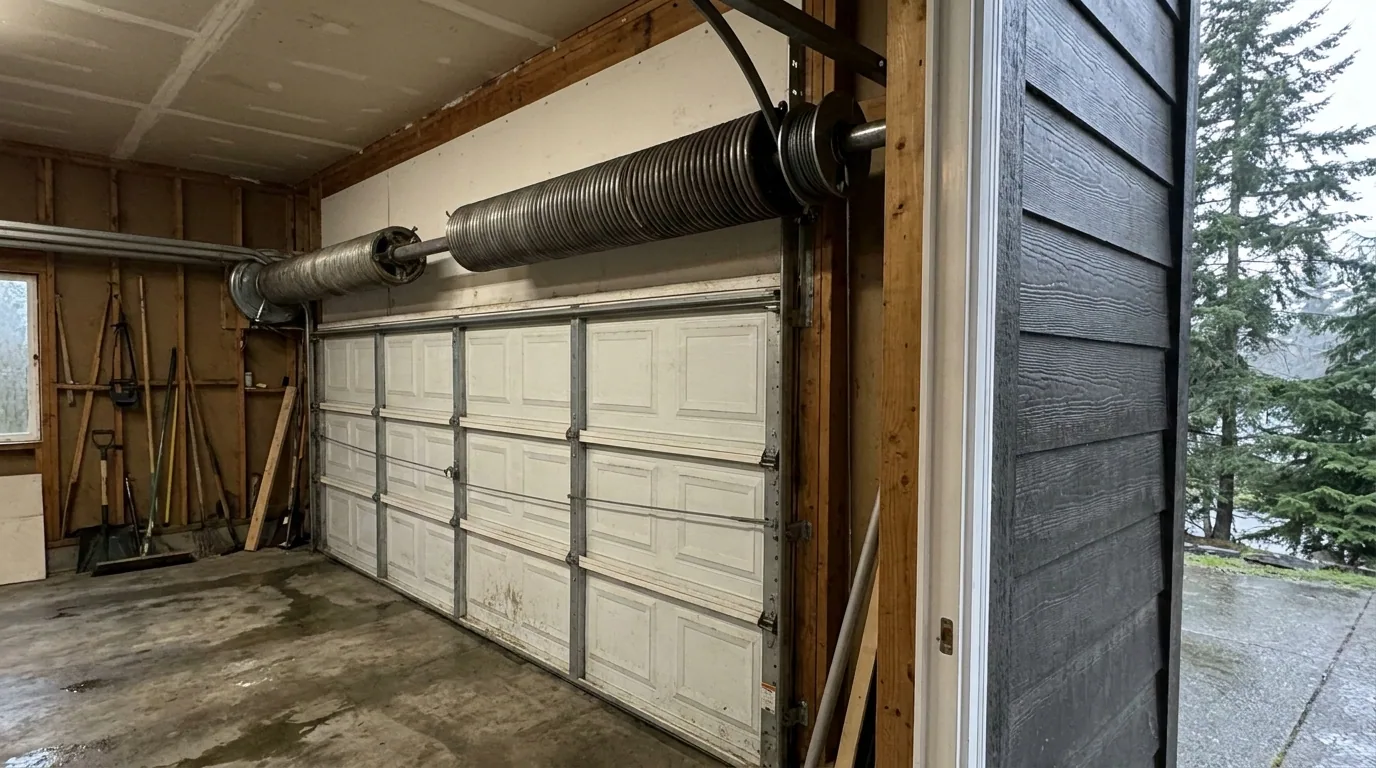
On a standard sectional door, the cables run from the bottom corners of the door up to the drums at the ends of the torsion shaft. They are what ties the door to the spring system. The springs carry the door's weight; the cables are the link that transmits that lift to the bottom of the door and keeps both sides rising together. When a cable is intact, the door travels level and the spring does its job through the whole cycle.
When a cable is frayed, that link is compromised. Strands have broken somewhere along the run, and the remaining strands are carrying a load they were not sized for. The cable does not need to snap outright to cause trouble. A cable that is partially failed can let one side of the door lag, and the door will start to bind against the track.
What you can see from outside the door
You do not need to go near the cables to notice the effects. With the garage empty and the door closed, stand back and watch a full cycle from the wall button, staying clear of the moving door.
- The door sits crooked in the opening, with one bottom corner higher than the other.
- One side of the door lags visibly as it rises, so the door goes up at an angle rather than level.
- The door feels heavier than it used to in normal use, or the opener sounds like it is working harder.
- A new noise at the start of the cycle, often a creak or a scrape from one side.
- A gap along the top of the door when it is fully closed, or a bottom seal that no longer meets the floor evenly.
Those are the visible symptoms. The condition of the cable itself is a technician's inspection, not a homeowner's. The strands are under tension, the cable is routed around a drum, and the assembly is not something to reach into.
Why a crooked door is not automatically a cable problem
A door that sits crooked can come from more than one failure. A snapped cable is one cause, and it is the one that produces the most dramatic angle. A broken torsion spring is another: with the spring no longer holding its share of the weight, the door can drop or hang unevenly. A bent or misaligned track is a third, and it can pull one side out of line without any cable damage at all.
The useful thing is not to guess but to let the observations narrow it down. A door that is crooked and will not move at all points one way. A door that is crooked but still runs, with one side lagging, points another. A door that is level but binding against one track is a different situation again. A technician separates these by inspecting the springs, cables, drums, and track together, because they work as a system and a failure in one loads the others.
What waiting actually costs
The reason to treat a frayed cable as urgent is not the cable. It is everything the cable touches.
A cable that is failing lets the door run out of level, and an out-of-level door puts side load on the rollers and hinges. Rollers that were fine start to wear at an angle. Hinges take a twist they were not designed for. The track can be pushed out of alignment by a door that is fighting it. The opener, meanwhile, is being asked to lift a door that is binding, and the added strain shows up in the drive train and the force settings.
None of that is catastrophic on its own. Together, it turns a single failed component into a list of them. The door also becomes less predictable: a cable that is down to a few strands can let go during a cycle, and when it does, the door drops on one side. That is a door that is no longer safe to operate, and it usually happens at the least convenient moment.
What to do when you suspect a cable
Stop running the door. If you have seen it hang crooked, lag on one side, or make a new noise from one corner, leave it closed and call for service. Do not pull the emergency release to move the door by hand, and do not try to straighten the door or reseat a cable yourself. The cables, springs, and drums are under tension and are technician work.
When you call, describe what you saw: which side lagged, whether the door still runs, and what it sounded like. That helps the technician arrive prepared. Liv Garage Door Repairs & Service handles cable repair and the related spring, roller, and track work across Auburn, Kent, Federal Way, Renton, Tacoma, Puyallup, Seattle, Enumclaw, Maple Valley, Covington, Bonney Lake, and Sumner. The number is (425) 386-7589, and the shop is at 5548 34th St SE, Auburn, WA 98092. Weekday hours are 7:00 AM to 8:00 PM Monday through Saturday, Sunday is emergency service only, and there is 24/7 emergency dispatch.
A cable is a small part of the door and an easy one to forget about until something else breaks. Replacing it while it is still a cable problem is the cheaper conversation. Waiting turns it into a door problem.